Stephanie Wilson: The NASA Astronaut Who Might Be the First Black Woman on the Moon
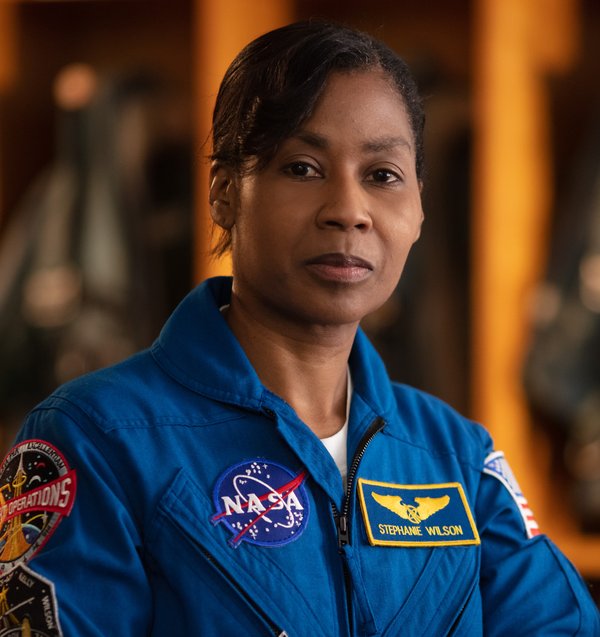
Let me tell you about Stephanie Wilson.
There are only a handful of Black women who have ever been to space. Stephanie Wilson is one of them — and here’s what’s wild: at 59 years old, she’s still on NASA’s active roster, still training, still in the room for Artemis. She might be the first Black woman to walk on the Moon.
Let that sink in. The second Black woman ever in space isn’t a history lesson. She’s still working.
The Work
Stephanie Wilson is a NASA astronaut — currently Branch Chief of the Mission Support Crew Branch in the Astronaut Office. She’s flown three Shuttle missions: STS-121 in 2006 (the return-to-flight after Columbia), STS-120 in 2007 (delivering the Harmony module to the ISS), and STS-131 in 2010. On every one, she operated the robotic arms. That’s the kind of precision work that keeps a crew alive hundreds of miles above the Earth.
Altogether, she’s logged roughly 42 days in space — the second-most of any African American female astronaut. And in December 2020 she was named to NASA’s Artemis team. Artemis is the program going back to the Moon. Which means Stephanie Wilson is on the short list of people who could make history as the first Black woman on the lunar surface.
The Roots
Born in Boston, raised around Pittsfield, Massachusetts. Harvard for engineering science (1988). A master’s in aerospace engineering from UT Austin (1992). Before NASA, she worked at Martin Marietta and JPL — including on the Galileo spacecraft, the one that flew to Jupiter.
She was selected as an astronaut in 1996. She’s also been CAPCOM in Mission Control — the voice astronauts hear from the ground — and a robotics instructor training crews to handle the station’s arm. This is a woman who has spent nearly three decades as one of the most quietly essential people in human spaceflight.
Why It Matters
Here’s what I want you to sit with: the next chapter of human space exploration is being written by a Black woman who’s been in the program since the 1990s. When little girls look up at the Moon, there’s a real chance the hands landing there belong to someone who looks like them.
That’s not inspiration theater. That’s a plan in motion.
Quick facts:
- Second Black woman in space (after Mae Jemison) — and still active
- 3 Space Shuttle missions: STS-121 (2006), STS-120 (2007), STS-131 (2010)
- NASA Astronaut since 1996 · Artemis program team member
- Branch Chief, Mission Support Crew Branch · former CAPCOM
- Harvard B.S. Engineering Science · UT Austin M.S. Aerospace Engineering
Photo: Photo: NASA (public domain)